All about the Fosa...
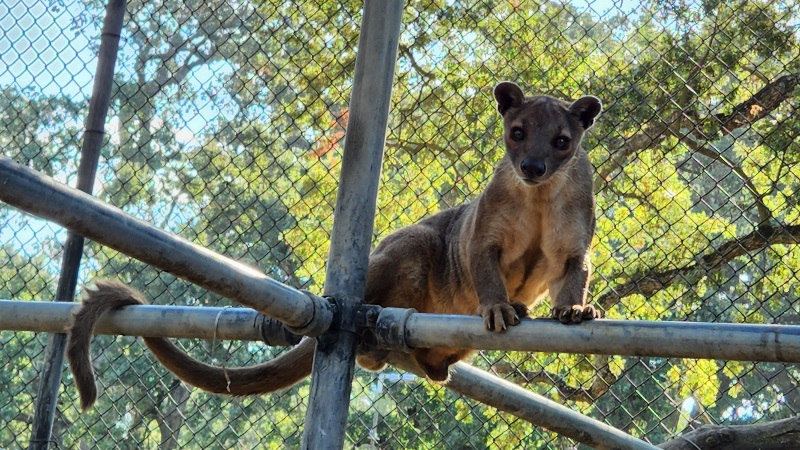
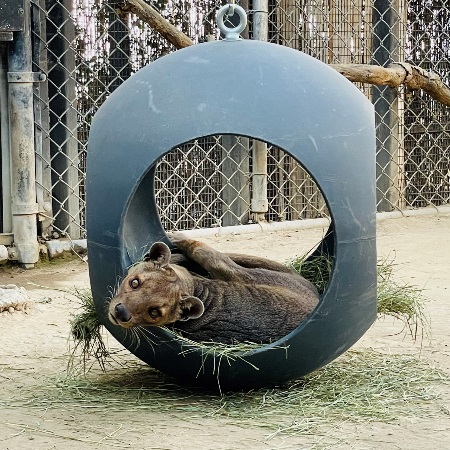
The fosa is closely related to weasels and mongooses. They are carnivores and sport several attributes that are similar to wild dogs and wild cats. They have glistening dark brown fur that helps camouflage them when they are out hunting prey. Like wild cats, the fosa has long bodies and equally long tails. As they spend a considerable proportion of their time in trees, their long tails help them balance when climbing trees and tree branches. Fosas also have flexible ankles that help them maneuver smoothly while climbing trees. With these ankles, they are also able to climb down head first. While wild cats have claws that retract, the fosa has semi-retractable claws. Like wild dogs, fosa has slanted, long, pointed snouts with whiskers. The fosa is active by night and depends on their advanced sense of sight, hearing, and smell to hunt their prey.
Male and female fosas are very similar in color, shape, and form with males being slightly heavier (14 to 20 pounds) than females (12 to 15 pounds). At 2.5 feet, their bodies are slightly longer than their tail lengths.
Diet
They are obligate carnivores and only feed on meat. They are considered the top predators in Madagascar and are known to feed on lemurs, birds, reptiles, amphibians, and invertebrates. A considerably large proportion of their diets consist of lemurs.
Habitat
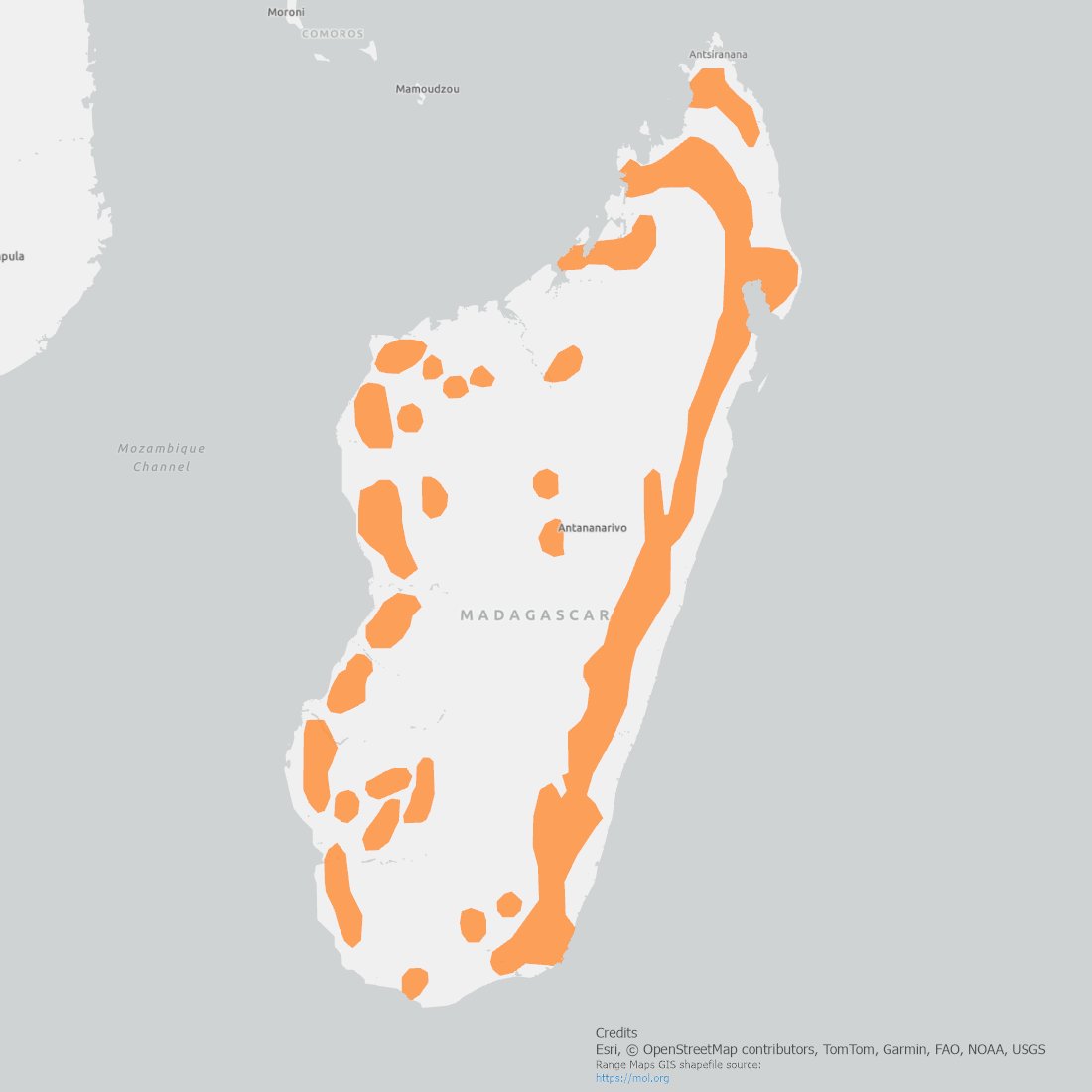
Fosas are endemic to Madagascar and are only found in tropical rainforest habitats.
Behavior
Fosas are solitary by nature pairing only during the breeding seasons. Like wild cats, fosas defend a territory within which, they hunt and feed, rest, and have young. They scent-mark their territorial boundaries with urine. The territories of males are considerably larger than those of females and overlap significantly. While the males spend their time surveying their territories and protecting their females and offspring, from competitors, females focus on taking care of and training their young.
The fosa’s vocalizations are very similar to that of wild cats. They purr, mew, hiss, and yelp. They are either active by night (nocturnal) or at dawn or dusk (crepuscular). Their biological rhythm of hunting when their prey sleep, helps increase their hunting success by. They are adept climbers moving effortlessly between trees in thickly vegetated tropical rainforests. Their well-built muscular bodies, and fore and hind legs aid them in climbing and running helping them to effectively hunt prey both on the ground and in trees.
Reproduction
Their breeding season occurs in the fall and offspring are born in the winter months. Fosas follow a unique mating system where the female chooses whom she mates with. She will either select one male or mate with multiple males. She delivers her young in a sheltered area such as tree hollows, dens, or holes in the ground. Usually, two to four young are born. They stay with their mother for around five months during which time she nurses and feeds them till they are weaned. Young fosas live with their mothers for 15 to 20 months after which, they disperse to form their territories. During the time they spend with their mothers, they learn to hunt and feed themselves and maintain territories.
Conservation
The fosa is categorized as VULNERABLE by the World Conservation Union because of depleting numbers, loss of habitat, habitat fragmentation, conversion of forest to agricultural lands, logging and wood harvesting, illegal hunting, and trapping. The Association of Zoos and Aquariums (AZA) is focused on conserving this species through its Species Survival Plan (SSP). Zoos across the United States, Canada, and Mexico are involved in this program and several zoos are selected to breed fosas in order to increase their population in the zoo community. AZA’s SSP is also linked with other zoos globally and several individuals have been moved internationally to add new genes to increase genetic diversity. AZA also focuses on conserving fosas by being a part of the Wildlife Trafficking Alliance. Through this alliance, they work with their partners to reduce and eventually eliminate, the illegal trade of wildlife and wildlife products.